

Working Capital
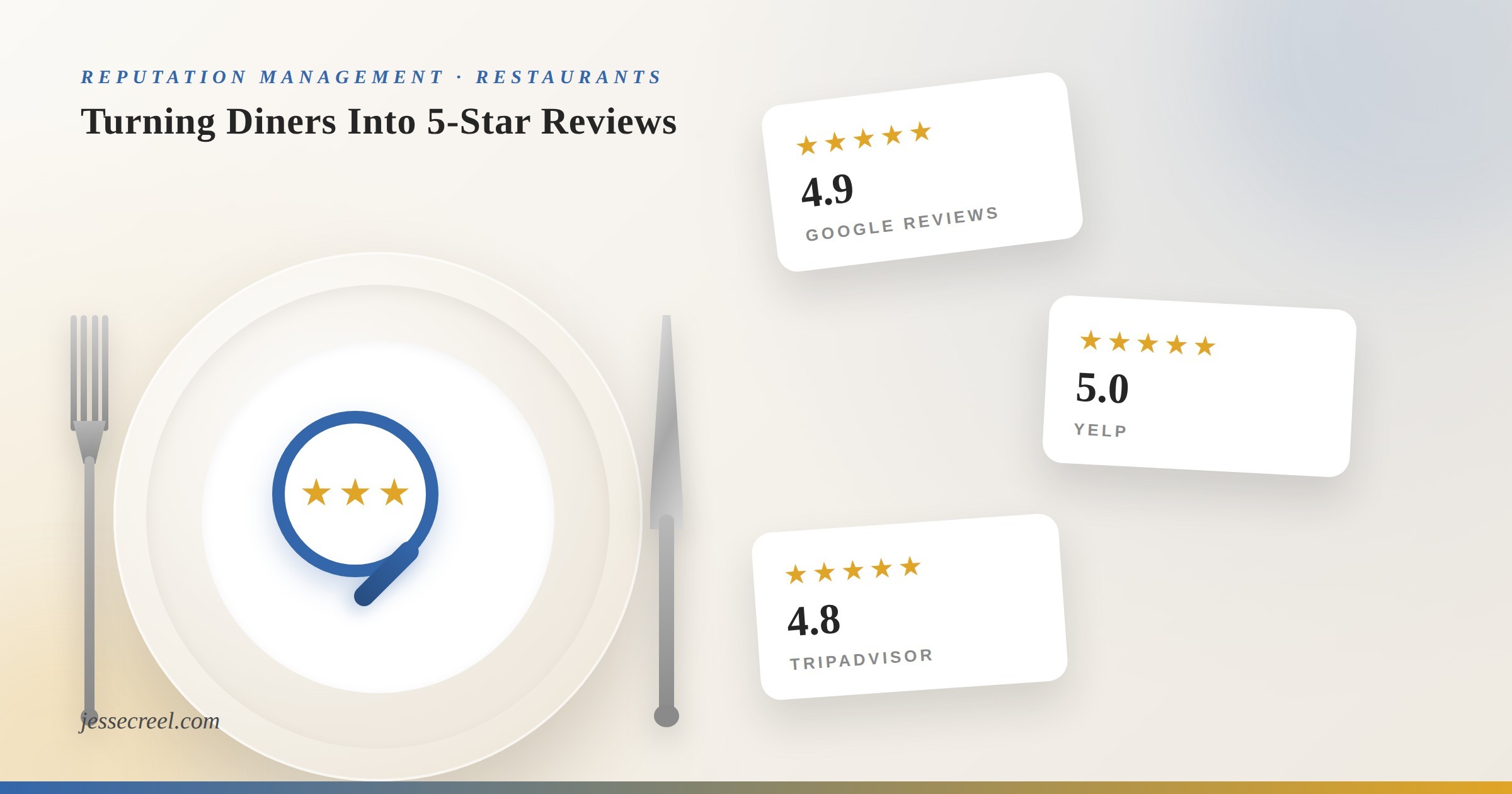

If you own a restaurant, you already know reviews matter. What most owners don't realize is how much money they're leaving on the table by only paying attention to one of them.
Here's the number that should change how you think about this: diners check Yelp before walking into a restaurant almost as often as they check Google, and they check TripAdvisor before booking a trip that includes a dinner reservation at almost the same rate. If your review strategy begins and ends with "ask people to leave a Google review," you're actively invisible on two of the three platforms deciding whether someone picks your restaurant tonight.
This guide walks through exactly how to build a real review-generation system across Google, Yelp, and TripAdvisor — not just how to ask for reviews, but how each platform's algorithm actually treats those reviews once you get them, why the obvious tactics backfire on at least one of these platforms, and how to handle the negative reviews that show up no matter how well you run your restaurant. By the end, you'll have a system you can actually run every week, not a one-time push that fizzles out in a month.
Google gets all the attention because it's the platform every local business owner has heard of. Google Business Profile is free, it's the first thing that shows up when someone searches your restaurant's name, and the star rating sits right there in the search results and on the map. It's an obvious, visible target.
But think about how people actually decide where to eat. A local searching "restaurants near me" on a Tuesday night is looking at Google. A visitor planning a trip three weeks out, or someone deciding between two restaurants they've never been to, is very likely to pull up Yelp or TripAdvisor first — especially in tourist-heavy areas, college towns, or any city where out-of-towners make up a meaningful chunk of covers. Yelp built its entire brand around being the more "honest," crowd-sourced alternative to a business's own marketing, which is exactly why skeptical diners trust it. TripAdvisor is the default app for anyone traveling, and it ranks restaurants specifically for people who aren't locals and have no idea which places are actually good.
If your Google rating is a strong 4.7 but your Yelp page hasn't been touched in two years and sits at 3.4, you don't have a reputation problem — you have a reputation gap. Prospective customers who cross-check (and plenty do) will notice the inconsistency, and it reads as a red flag: either the Google reviews aren't representative, or something changed and the Yelp reviews are more current. Either way, you lose the benefit of the doubt.
The fix isn't complicated in concept — you need a real system on all three platforms, not just the one that's easiest to check. But the tactics that work on each platform are different enough that copy-pasting your Google approach onto Yelp will actively hurt you, which is the next thing to understand before you touch any of this.
Every review platform has some kind of filtering or ranking system standing between "a review got submitted" and "a review is visible and counts toward your star rating." If you don't understand how each one works, you can spend real effort collecting reviews that never show up, or worse, that quietly damage your standing.
Google's rating is a straightforward average of all your visible reviews, but two things affect how much any single review matters to your visible reputation. First, Google weighs recent activity heavily in how prominently your business shows up in local search and map results — a business with a steady trickle of new reviews reads as more "alive" and relevant than one that got forty reviews in 2022 and nothing since. Second, review velocity (how often new reviews come in) is itself a ranking signal, separate from your star average. A restaurant with a 4.5 rating and five new reviews a week can outrank a 4.7-rated competitor whose last review is from eight months ago.
The practical takeaway: consistency beats one-time pushes. A burst of forty reviews in one week, followed by silence for six months, is a worse pattern than five or six new reviews trickling in every week, indefinitely. Google can also detect unnatural patterns — a sudden spike in reviews from accounts with no other activity, all posted within hours of each other, is exactly the kind of thing that triggers a manual review or review removal. Anything that looks incentivized, coordinated, or bulk-generated risks the reviews being stripped and, in repeat cases, your listing being suspended entirely.
Yelp is different from every other platform in one critical way: it runs an automated recommendation filter that hides a large percentage of submitted reviews from your public page (they still exist, in a "not recommended" section most consumers never find, but they don't count toward your star rating or review count). Yelp doesn't fully disclose how the filter works, but the pattern is well understood after years of business owners tracking it: the filter is more likely to flag reviews from brand-new Yelp accounts, accounts with very few other reviews, reviews posted in a tight cluster of time, and reviews that read like they were prompted (generic, overly positive, mentioning things a real customer wouldn't naturally mention, like your marketing taglines).
This is exactly why the tactic that works great on Google — handing every table a card that says "please leave us a review" — is the thing most likely to get your Yelp reviews filtered. If you send a wave of customers to Yelp all at once, especially if several of them have thin or brand-new Yelp profiles, Yelp's system reads that as suspicious activity regardless of whether the reviews are genuine, and quietly buries them.
The better approach on Yelp is patience and organic-feeling timing: encourage happy customers to review you on their own initiative rather than in a synchronized push, and favor customers who are already active Yelp users (people who mention checking Yelp, or who you can see checked in via Yelp) since their reviews carry the filter's trust more easily. This is slower than the Google approach, which is exactly why most restaurants give up on Yelp — it takes a real system, not a one-time card on the table, to move the needle here.
TripAdvisor ranks locations using what it calls a "popularity" algorithm based on the quality, recency, and quantity of reviews, and it explicitly favors businesses with a steady, ongoing flow of reviews over one dominated by old ones. But the bigger practical challenge with TripAdvisor is that it's fundamentally built around travel — plenty of your regulars and locals will never think to review you there because they don't associate TripAdvisor with "the place I eat dinner near my house." Your TripAdvisor reviews are disproportionately going to come from visitors, which means your total volume of realistic reviewers is naturally smaller than on Google or Yelp, and your ask has to be timed and framed differently (more on that below).
TripAdvisor's terms of service also explicitly prohibit offering any kind of incentive — discount, free item, entry into a drawing — in exchange for a review, and they actively investigate and remove reviews (and can penalize the whole listing) when they detect incentivized review campaigns. This is worth being extremely careful about, because it's an easy line to cross accidentally if you're running a "leave us a review for 10% off your next visit" promotion that you assumed only applied to Google.
Across all three platforms, the single biggest lever you have is timing. Almost every restaurant that struggles with reviews is asking at the wrong moment or not asking at all, and almost every restaurant that has a strong, current rating across platforms has built some version of the same underlying habit: catching customers at their happiest point and making the ask frictionless right then, rather than hoping they remember to do it later that night or the next day.
The data on this is consistent across every platform: the likelihood that a customer actually leaves a review drops sharply with every hour that passes after their visit. Someone who just finished a great meal, is still at the table or walking out the door, and has their phone in hand is dramatically more likely to leave a quick, genuine, positive review than that same person getting a text the next morning asking them to "take a moment" to review their experience from the night before. Life happens, the moment passes, and the review never gets written — or worse, it gets written days later when a minor issue (bad traffic on the way home, nothing to do with your restaurant) has colored their memory of the visit.
This is why the restaurants that do this well build the ask into the actual dining experience rather than treating it as a follow-up marketing task.
The friction between "I had a great time" and "I left a review" needs to be as close to zero as possible. A few methods that consistently outperform a generic "please review us" request:
Notice that none of these methods blast every single customer with an identical, synchronized request — which matters most on Yelp, for the filtering reasons covered above, but is good practice everywhere. A system that naturally staggers requests based on when tables actually finish their meals looks organic because it is organic.
"Please leave us a review" is a weaker ask than something that tells the customer exactly what to do and exactly where. Specify the platform if you're asking for one in particular ("if you have a Yelp account, we'd love a quick review there — we're a bit under-reviewed on Yelp compared to Google"), and keep the language natural rather than corporate. Reviews that come from an ask that feels like a genuine, specific request from a person tend to read more authentically too, which — on Yelp especially — matters for whether the review clears the filter.
No matter how well you run your restaurant, negative reviews are going to happen — a bad night, a miscommunicated order, a customer who was already in a bad mood before they walked in. What actually matters is how you handle it once it's posted, and the right move is different on each platform.
Google reviews can occasionally be removed if they violate Google's content policies — reviews that are clearly fake, contain hate speech, are posted by a competitor, or have nothing to do with an actual visit (a review complaining about your policies but never mentioning food or service, for example) can be flagged for removal through Google Business Profile. But most negative reviews are legitimate complaints and won't be removed, which means your real tool is a thoughtful public response.
A good response acknowledges the specific issue without being defensive, briefly explains what happened if it's relevant (without making excuses), and offers to make it right offline ("please reach out to us directly at [phone/email] so we can address this properly"). This does two things: it shows the unhappy customer you're taking it seriously, and — more importantly for your reputation long-term — it shows every future customer reading that review that you respond like a business that cares, which often neutralizes the negative review's impact almost entirely.
Yelp works similarly to Google in that you can publicly respond to any review, and Yelp also allows business owners to message reviewers privately. The key difference is that Yelp's community and the way search engines index Yelp pages means a defensive or combative public response tends to do more damage than the original negative review — Yelp reviewers and readers are generally more sensitive to businesses that appear to be arguing with customers. Keep public responses short, calm, and solution-oriented, and move any real back-and-forth to a private message or a phone call.
Yelp will remove reviews that violate its content guidelines (fake reviews, conflicts of interest, reviews about a different location, hate speech, and similar), which you can report through Yelp's business tools — but legitimate negative experiences, even ones you disagree with, generally stay up. Don't spend energy trying to get real negative reviews removed; spend it on responding well and on generating enough genuine positive reviews that one bad one doesn't define your page.
TripAdvisor is used heavily by people who've never been to your restaurant and are relying entirely on other people's accounts to decide whether to book, which means your response to a negative review is doing double duty — it's not just for the unhappy reviewer, it's for every future traveler deciding whether your restaurant is a safe bet. TripAdvisor explicitly encourages management responses and displays them prominently under each review, so a pattern of thoughtful, professional responses across your negative reviews becomes a visible asset on your page, not just damage control.
TripAdvisor also has a formal review-removal process for reviews that violate its guidelines, and — like Yelp — will investigate and remove reviews connected to incentivized campaigns, conflicts of interest, or content that doesn't reflect an actual visit.
The pattern across everything above is the same: platforms reward businesses that generate reviews steadily over time, and they're increasingly good at detecting (and penalizing) businesses that try to shortcut that with a burst of activity. That means the real goal isn't "get to 100 reviews" as a one-time project — it's building a habit that runs every single service, indefinitely, with minimal ongoing effort from you or your staff.
In practice, that means:
This is exactly the part that most independent restaurant owners struggle to sustain — not because the tactics are complicated, but because running a restaurant already takes every hour in the day, and "manage three separate review platforms consistently, forever" is a hard thing to keep prioritized against tonight's service.
A review system without measurement is just activity. A few numbers worth checking monthly, across all three platforms:
This is usually a math effect, not a sign anything got worse: if your review velocity has slowed down, older reviews (including old negative ones) make up a larger share of your total average, and a rating that was propped up by a burst of recent 5-star reviews will drift back down once that burst stops. It can also happen if a review you didn't notice was posted, or if Google recalculates weighting after a policy update. The fix is the same either way — get back to a steady, ongoing flow of new reviews rather than treating it as a one-time project.
No — every major platform (Google, Yelp, and TripAdvisor) explicitly prohibits incentivized reviews in their terms of service, and all three actively detect and remove reviews connected to incentive campaigns, sometimes with penalties to the whole listing. It's fine to thank customers generally or run a separate loyalty program, but the review itself can never be tied to a reward.
Each platform has a reporting/flagging process for reviews that violate its content policies (fake reviews, reviews from someone who was never a customer, hate speech, conflicts of interest, and similar). Removal isn't guaranteed and can take time, and it will not work for reviews that are simply negative but legitimate — those you handle through a good public response instead, not a removal request.
No — target the ask toward customers who've clearly had a good experience (based on what you can observe: clean plates, positive comments, repeat visits), rather than asking every table indiscriminately. This matters most on Yelp, where a synchronized blast to everyone looks unnatural to the filter, but it's good practice everywhere: a targeted ask converts better and produces more genuinely positive reviews.
It's worth having a claimed, accurate, decently-reviewed TripAdvisor listing even in a mostly-local market, because you can't fully control who ends up checking it — visiting family, business travelers, anyone new to the area — but it's reasonable to prioritize Google and Yelp first if your customer base is overwhelmingly local, and treat TripAdvisor as the third platform you build out once the first two are solid.
Getting more 5-star reviews isn't really about any single trick — it's about running a consistent system across all three platforms your customers actually use, understanding that each one plays by different rules, and responding to what comes in (good and bad) instead of ignoring it. Restaurants that do this well don't necessarily have better food than their competitors — they just do a better job of making sure the internet actually reflects how good they are.
If you want to see exactly where your restaurant currently stands against the competitors down the street — across Google, Yelp, and TripAdvisor together, not just one platform — you can run a free competitive analysis. It takes about 90 seconds, there's no credit card required, and you can start completely free if you like what you see.